
Azure App Service FlexDeploy Architecture
This document outlines the details of an Azure App Service v3 environment for the FlexDeploy SaaS offering.- SaaS - Data storage limits
- Hybrid connections in Azure App Service
- Flexagon SaaS Certifications
- FlexDeploy SaaS Email Integration
- Customer Data and Information in Flexagon platform
- Flexagon SaaS Single Tenant Model
- Flexagon SaaS upgrade process
Architecture Overview
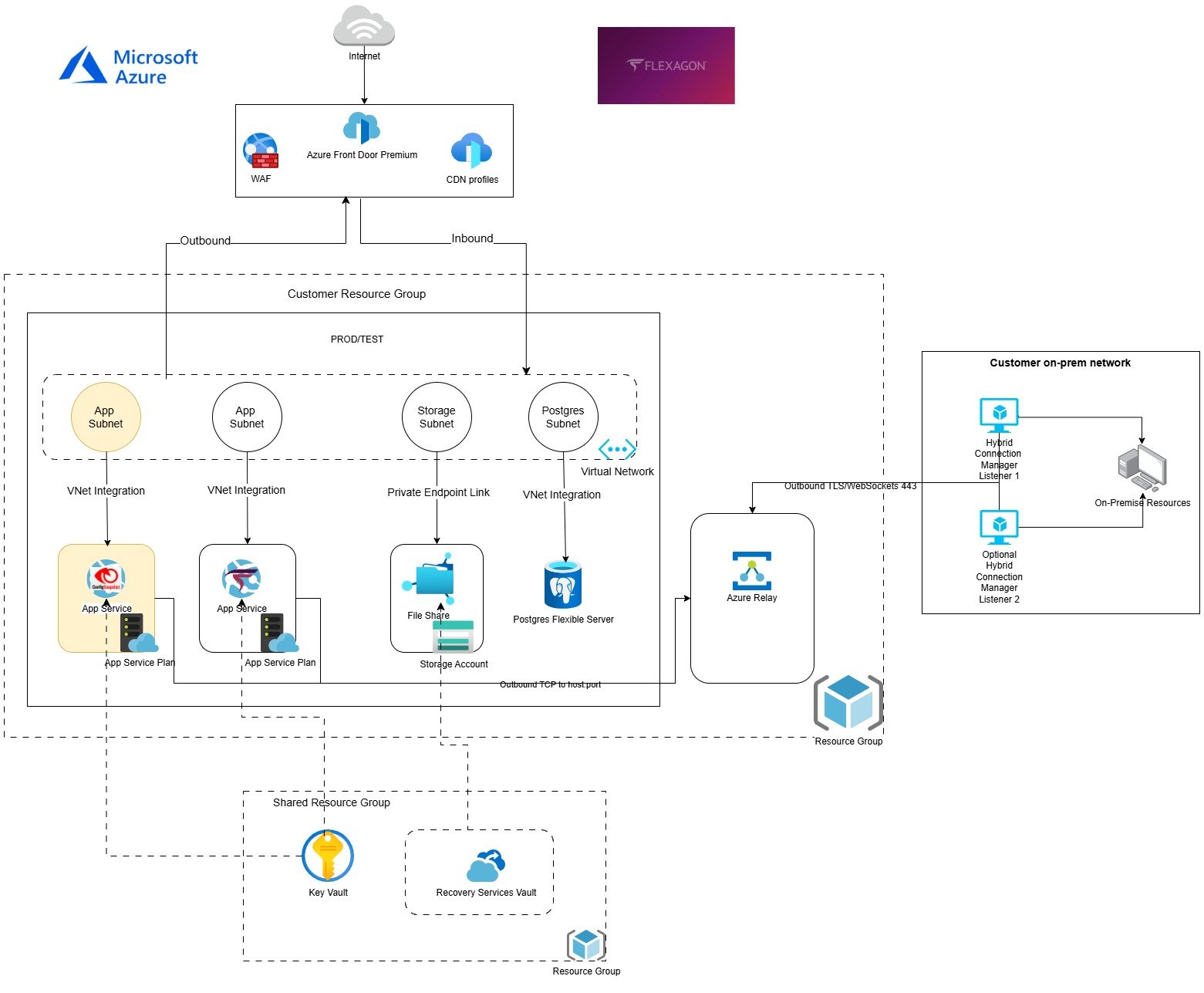
Details of Architecture
- Each customer will have
- Global security settings like TLS and encryption settings
NAT Gateway
- Simplifies outbound internet connectivity for virtual networks
- When configured for a subnet, all outbound connectivity uses the NAT gateway’s static public IP addresses
Virtual Network
- Enables Azure resources to communicate with each other, the internet, and on-premises networks
- can leverage other components to enable VPN, routing, and network filters among others
DDOS Protection
https://learn.microsoft.com/en-us/azure/ddos-protection/ddos-protection-overviewWAF (Web Application Firewall)
https://learn.microsoft.com/en-us/azure/web-application-firewall/ag/ag-overviewApp Service Plan
- Operating system specified (Linux vs Windows)
-
Hardware specifications including:
- Number of virtual CPUs
- Amount of memory
- Number instances (number of VMs)
- Capability to scale up the size of an instance
- Capability to scale out the number of instances
App Service / Web App for Containers
- Tied to an App Service plan to provide hardware footprint
- Slots to deployment a custom FlexDeploy docker container
- Up to 100 slots are available in a given App Service plan
-
Configuration / Application settings
- Allows definition of specific properties that are passed to the container
- Includes PostgreSQL URL and database credentials
- Includes InfluxDB properties
- Determines what port is exposed for the application
- Credentials can be stored in an Azure Key vault
-
Configuration / General Settings
- Allows for container specific HTTP and TLS settings
- Allows for container specific SSL certificate handling settings
- Allows for an optional startup command to run with the container startup
-
Configuration / Path mappings
- Allows for external Azure Storage Mounts to be added to the container
- Azure Files storage will be mounted to provide for storage of artifacts, InfluxDB data, and other customer data to make it external to the actual FlexDeploy container
-
Authentication
- Provides capabilities to force application to authenticate with things like Google/Azure Active Directory/Twitter/Facebook among others.
- Azure Active Directory would allow for limiting access to launching the URL to only users defined in AD for example.
- Application Insights provides application level monitoring and alerting capabilities
- Identity provides capabilities to define an Azure AD identity that would allow you to provide access to a specific secret in an Azure Key Vault for example.
- Custom Domains provides ability to customize the domain name of the application. Custom domains can be purchased and added here.
- Certificates allow for the adding and maintaining of SSL certificates
- Networking / Access restrictions allows for restricting access to the web site by things like IP address or HTTP header
PostgreSQL Flexible Server
- A PostgreSQL flexible server instance is provisioned for each custom
- FlexDeploy database is created and the schema with related objects is created in that instance
- Configuration setting in the App Service are configured to point to the PostgreSQL instance
- Compute, memory, and storage definitions are defined at creation but can be changed after deployment
- Default networking configuration only allows connectivity to the database from within Azure
- Data is encrypted in the database
Azure File Share
- Created within an Azure storage account that is provisioned with a maximum size
- Individual file share is created within that storage account’s maximum size with a defined quota
- File share is mounted to App Service container using the configuration path mapping feature